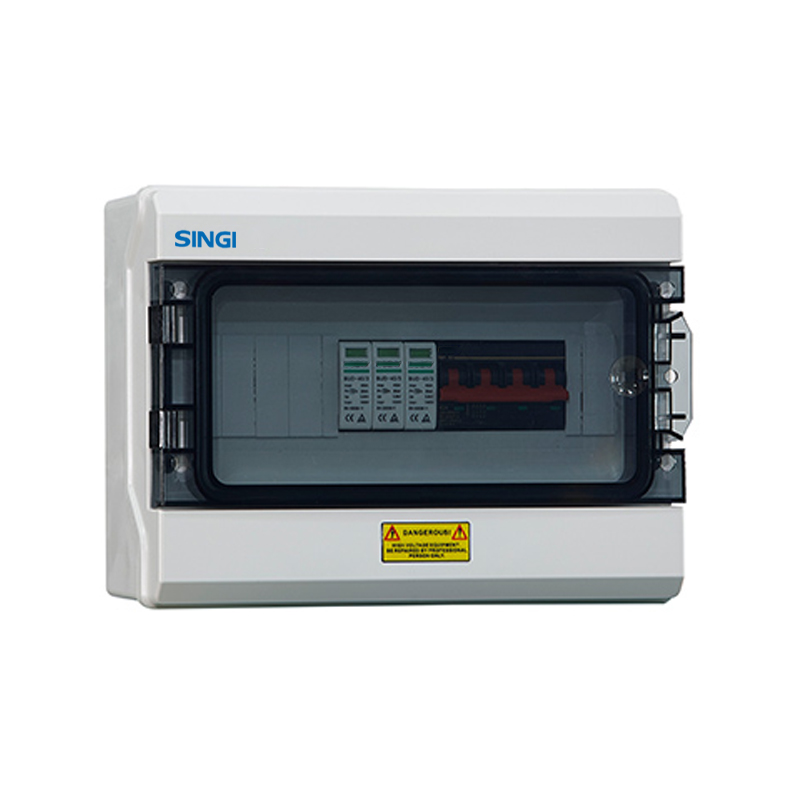
A DC combiner box is an enclosure that connects multiple PV strings into a single DC output. The singielectric 600V/1000V DC combiner box 2 in 1 out YB2/1 accepts two strings on the input side and delivers one combined circuit on the output side. That compact arrangement is common on small commercial rooftops, solar carports, DC-coupled storage systems, and residential arrays that use one inverter input or one MPPT track for two strings.
The YB2/1 is not a junction point. It provides a dedicated location for fusing, disconnection and wiring management, which makes later maintenance and troubleshooting far easier. Because each input string can be fused independently, a combiner box prevents a faulty string from dragging down the whole array. For a 600V or 1000V DC system, this protection role is essential.
In projects where only two strings need to be paralleled, a larger combiner box would be oversized. The YB2/1 combiner box matches that specific need with a neat, economical layout. Singielectric positions it as part of a broader series of photovoltaic distribution products, but it is designed exactly for these two-string applications.
The 2-in-1-out topology immediately defines the boundary of the feeder circuit. Two source circuits enter the enclosure and one output circuit leaves. This configuration is structurally simple, but it must still isolate each string for service. Without individual fuse holders or disconnectors inside the box, one damaged string could affect the entire inverter input.
An engineer should confirm that the input terminals on the YB2/1 600V/1000V DC combiner box are spaced enough for safe volt-level separation. The output side should use a single pair of terminals with a clear cable path. This reduces internal wire congestion and makes torque checking possible during installation. Singielectric’s enclosure design is arranged so each string is visibly identifiable, which cuts down on commissioning errors.
DC circuits have different arc behaviour compared to AC. Without a natural amperage zero-crossing, a DC arc is harder to extinguish. That is why a photovoltaic combiner box must rely on properly rated fuses, a manual disconnect switch, and a mechanical enclosure that contains any arc energy.
The singielectric 2-in-1 DC combiner box is fitted with fuse holders for each input string. The fuse rating must match the PV module’s maximum-val series fuse rating. A surge protective device is also recommended for overhead or lightning-exposed installations. While not every project requires an SPD at the combiner level, adding one inside the YB2/1 can simplify the overall protection design.
Another important characteristic is the ability to isolate the inverter from the PV array for maintenance. A DC-rated switch or pull-out fuse carrier can provide full disconnection. The enclosure should also be manufactured from UV-resistant, corrosion-resistant material, since it may be installed outdoors for 20 years or more.
The volt-level rating of a DC combiner box is not a number to ignore. It must match the maximum-val system volt-level of the PV array, which is measured at cold temperature. Operating a 600V-rated box on a 1000V circuit could break down insulation and create a permanent arc risk. The YB2/1 is available for either 600V or 1000V DC systems to align with the inverter and panel class.
| System Volt-level | Common Application | Influence on String Design |
|---|---|---|
| 600V DC | Small residential and commercial PV in certain North American markets | Shorter string length, higher operating amperage per string |
| 1000V DC | Commercial and utility-scale PV in Europe, Australia and many Asian countries | Longer string length, reduced I²R losses on the DC side |
The amperage path must also be examined. Since the YB2/1 carries two strings into one output, the output amperage is the sum of the two incoming strings under normal operation. Check the output cable rating and the continuous ampacity of the terminal block. Fuse sizes should be chosen according to the short-circuit amperage of the connected modules.
All current-carrying connections must satisfy low contact resistance. Copper busbars or terminal blocks inside the combiner box reduce the chance of hot spots. When sourcing the YB2/1, you should confirm the current-carrying parts and conductor sizes match the expected array current.
Installation speed is a tangible cost factor on every PV project. A well-marked input area and a wide working space inside the 600V/1000V DC combiner box YB2/1 allow installers to terminate cables and correctly. Cable glands or knockouts on the enclosure should support the outer diameter and number of cables needed for a two-string system.
For maintenance, think what happens during an inverter service or a fuse replacement. The fuse holder should be reachable without dismantling the entire box. A transparent cover or a clear status indicator can also shorten troubleshooting time. Grounding points should be positioned in a way that keeps the PE cable separate from DC power cables, avoiding interference.
Many distributors ask spare parts. It is prudent to keep one or two fuse carriers as spares in the warehouse because fuse carriers may be used on every DC combiner box in the field. Singielectric supports replacement parts for the YB2/1 line, which helps maintenance teams minimise downtime.
Professional engineering buyers should not rely only on a datasheet. The design of a photovoltaic DC combiner box needs to be validated against internationally accepted standards. In addition to IEC 62548 for PV array design, the enclosure and its switching components should meet the requirements of IEC 60947-1 for low-volt-level switchgear and IEC 60269-1 for fuses. A manufacturer that can provide test reports or relevant certificates is more trustworthy.
Ask direct questions component origin, insulation material, and IP rating. The YB2/1 series from singielectric is manufactured with these standards in mind. Site engineers should also confirm the operating temperature range of the combiner box, since sunlight can heat an unventilated enclosure above the rated temperature limits.
If the buyer intends to sell into a target region, verify whether the product has the required local certification, such as UL in North America or CE marking in Europe. The singielectric sales representative can provide documentation for the YB2/1 and explain how it maps to a specific inverter or PV module portfolio.
Q: Can a 2-in-1 DC combiner box be used with a microinverter or a string inverter?
It is designed for string inverters and DC-coupled systems where two source circuits are paralleled. It is not intended for microinverter AC circuits.
Q: What happens if only one string is connected?
The unused input can be left disconnected if it is protected with a terminal cap or a blank fuse holder. Always follow the manufacturer’s instructions for unused inputs.
Q: Does the YB2/1 include a surge protective device?
The combiner box can be specified with or without an SPD, depending on the project requirement. Rainy and lightning-prone sites should always include one.
Q: What is the main reason to choose a 1000V DC rating instead of 600V?
A 1000V rating allows longer strings and reduces DC wiring loss in larger commercial arrays. Confirm that the inverter and modules also support 1000V system volt-level.
Q: How do I choose the correct fuse for each input?
The fuse rating should be above the normal operating amperage and below the cable and module rating. Calculate the maximum-val string fuse rating from the PV module datasheet.
For a reliable and clean DC combination point, review the singielectric 600V/1000V DC combiner box 2 in 1 out YB2/1 against your next project specification. Contact the singielectric team to confirm the exact volt-level rating, fuse configuration and enclosure options needed for your installation.
 References [1] IEC 62548:2016. Photovoltaic (PV) arrays - Design requirements. International Electrotechnical Commission, 2016. [2] IEC 60947-1. Low-volt-level switchgear and controlgear - Part 1: General rules. International Electrotechnical Commission, 2020. [3] IEC 60269-1. Low-volt-level fuses - Part 1: General requirements. International Electrotechnical Commission, 2020.