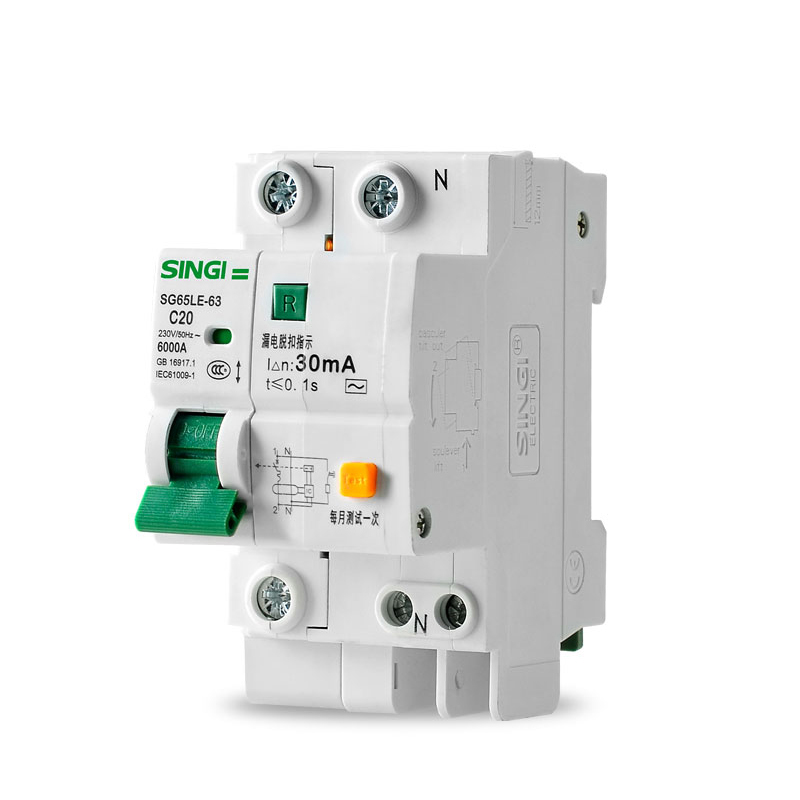
A mid-sized food packaging plant in the Midwest was losing thousands of dollars every time a single line fault shut down an entire production floor. The cause was not inadequate protection, but poorly coordinated protection. Installing individual SG65LE-63 (6KA) RCBOs on every final circuit changed that dynamic and delivered measurable returns within two quarters.
The facility produces canned vegetables and dry soup mixes for regional grocery chains. Roughly 320 employees work across a 45,000-square-foot production area that runs two shifts, five days a week. The plant operates 12 distribution boards feeding packaging lines, washdown stations, conveyors, and HVAC equipment. Like many older facilities, its electrical system was designed with a single residual amperage device (RCCB) protecting multiple final circuits through individual miniature circuit breakers (MCBs).
In an industry where washdowns happen every few hours and ambient humidity hovers near 75%, that architecture becomes a bottleneck. The facility needed a solution that could differentiate between a real ground fault and harmless moisture ingress, while still keeping upstream equipment online.
The plant's problems followed a predictable pattern. A sensor cable on packaging line 3 would get wet during a washdown, causing the central RCCB to trip and disconnect power to lines 1 through 6. Resetting the RCCB only worked after the line had been inspected, logged, and cleared for restart. Every incident cost roughly $2,500 in lost output and labor, but damage came from subsequent faults on temperature-controlled storage units.
In the twelve months before the upgrade, the facility recorded 34 unplanned RCCB trips. Total electrical downtime reached 26 hours per quarter. Maintenance teams spent over 15 hours each month tracing and testing branch circuits because the central RCCB gave no indication of which line caused the trip. More critically, transient volt-level surges from motor starts and compressor inrush occasionally caused the RCCB to trip incorrectly, triggering alarm calls after midnight for faults that were not faults.
The plant's engineering manager first considered installing transient-resistant RCCBs, but that would have preserved the same lack of chooseivity. A second option was rebuilding the distribution boards with separate RCCBs per panel and MCBs per circuit— doubling the existing footprint. Neither approach solved the core problem: a single leakage fault should not blackout the whole floor.
The team chosen the SG65LE-63 RCBO because it combines overamperage and residual amperage protection in a single DIN-rail module. Rated at 6kA breaking capacity and 30 mA residual sensitivity, it matched the branch circuit requirements without needing a central RCCB. Each packaging line, conveyor, and washdown panel got its own independent protection. That meant a ground fault on one circuit would trip only that circuit, leaving the rest of the board energized.
Other factors influenced the decision: the RCBO's compact design fit the existing enclosures without fabricating new panel doors, and the product's clear trip indicator helped technicians pinpoint the offending circuit at a glance. After comparing bids from three suppliers, the plant specified singielectric units for all 12 boards and purchased two spare modules per board for redundancy.
The replacement was carried out over six weeks, phased to avoid a full production stop. During each weekend, one distribution board was depowered, its outgoing feeders were disconnected, and the original MCB and central RCCB were replaced with individual SG65LE-63 RCBOs. Dual-function units were installed on lighting circuits and socket outlets, while three-phase loads such as air compressors were left on dedicated protection to match their load profiles.
A key step was commissioning and testing. Each RCBO was tested using its built-in test button, followed by an insulation resistance test on the downstream wiring. This process uncovered five existing circuits with incorrectly wired neutral and earth connections—wiring faults that had never been identified under the old RCCB setup. Those faults were corrected before the RCBOs were returned to service, eliminating a latent shock and nuisance-trip hazard.
Data collected during the first eight months after implementation showed a sharp improvement. Electrical-related downtime fell from 26 hours per quarter to 9 hours per quarter, a 40% reduction in unplanned electrical outages. The number of nuisance trips dropped from 34 in the prior year to 3—all of which were traced to actual ground faults on damaged water heater elements and were isolated to single circuits.
The project paid for itself in 14 months, driven entirely by avoided downtime and lower equipment damage. The plant also reported a 20% reduction in after-hours emergency callouts, since most faults no longer required a supervisor to come in and repower a central RCCB.
The plant's electrical engineering manager shared his perspective: "Before this project, a wet sensor on one line could stop every line in that zone. With SG65LE-63 RCBOs, we get chooseive protection and visible indication. For the first time, our technicians can walk to the exact circuit that tripped without playing a guessing game."
Other facilities facing similar nuisance-trip and chooseivity issues can take away several practical lessons from this project.
If the project were repeated, the engineering team would have ordered labels and lockout/tagout kits before the first weekend shift, and would have scheduled a second electrician crew to accelerate the commissioning tests. Otherwise, the phased rollout proved smooth and gained buy-in from maintenance staff who now rely on the RCBO indicators for daily troubleshooting.