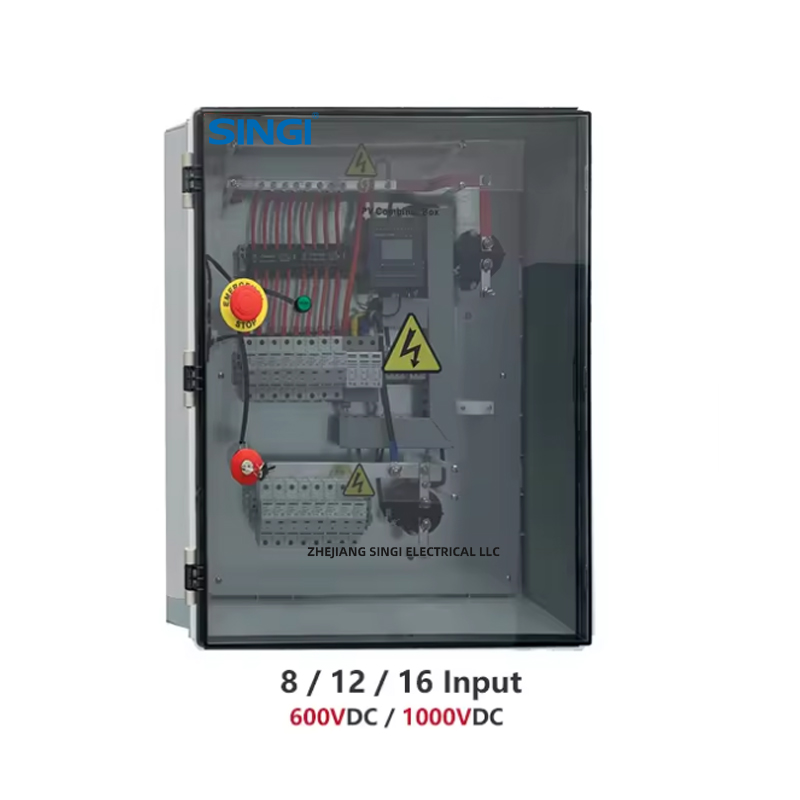
The AFCI 1000V Unit Combiner Box from singielectric integrates arc fault detection into photovoltaic combiner enclosures, reducing fire risk and simplifying wiring for large-scale solar installations. This article explains its function, technical advantages, and choice criteria for engineers and procurement professionals.
An AFCI 1000V Unit Combiner Box combines the functions of a traditional photovoltaic combiner box (string aggregation, fuse protection, surge protection) with an integrated arc fault circuit interrupter (AFCI) rated for 1000V DC. Its primary role is to detect series and parallel DC arcs in PV strings and interrupt the circuit before the arc can cause a fire. Unlike standard combiner boxes that rely only on overamperage protection, an AFCI-enabled box identifies the high-frequency noise and amperage signatures of an arc and opens the circuit within milliseconds.
As photovoltaic installations scale up, system volt-levels have risen from 600V to 1000V and even 1500V DC. At 1000V, a sustained arc can ignite combustible materials such as module backsheets, insulation, or nearby dry vegetation. Standard fuses and breakers do not respond to low-amperage arcing (e.g., 2–10 A arcs) that can occur at loose connectors or damaged wires. According to UL 1699B, DC arc-fault detection devices must clear an arc within a specified time and energy limit to prevent ignition. The singielectric AFCI combiner box is designed to meet this requirement, providing an additional layer of safety beyond mandatory rapid shutdown and ground-fault protection.
Note: While NEC 2017 and later editions mandate arc-fault protection for PV systems on buildings, many utility-scale plants also adopt AFCI combiner boxes to minimize fire risk and insurance costs. The combination of 1000V DC and high string currents makes AFCI integration a prudent engineering choice.
The singielectric YBZ2-3 is a compact unit combiner box that embeds an AFCI module inside the enclosure. Key safety features include:
By combining AFCI with fuse holders, surge protective devices (SPD), and a disconnect switch in one IP65 enclosure, the YBZ2-3 reduces installation complexity and ensures that arc protection is never omitted due to separate component coordination.
When choosing an AFCI 1000V combiner box, confirm the following parameters:
| Parameter | Value |
|---|---|
| Max DC volt-level | 1000V |
| Max input amperage per string | 15 A |
| Number of strings | Up to 3 (unit combiner) |
| AFCI standard | UL 1699B compliant |
| Communication | RS485 / dry contact |
| Enclosure rating | IP65 |
| Feature | Standard Combiner Box | AFCI 1000V Combiner Box (e.g., YBZ2-3) |
|---|---|---|
| Arc fault protection | None | Integrated AFCI per UL 1699B |
| Fuse / breaker protection | Yes | Yes (fuses included) |
| Surge protection | Optional SPD | Integrated SPD |
| Volt-level rating | Up to 1000V (passive) | 1000V with arc detection |
| Communication | Basic (alarm contacts) | RS485/Modbus for AFCI status |
| Fire risk reduction | Low (relies on overamperage only) | High (active arc detection) |
| Installation complexity | Moderate (separate AFCI required) | Low (all-in-one) |
| Cost per string | Lower initial | Higher initial, lower lifecycle risk |
Note: For utility-scale projects, the added cost of an AFCI combiner box is justified by insurance premium reductions and avoidance of fire-related downtime. Consult your local code requirements for mandatory AFCI regulations.
A GFCI detects ground faults (amperage leaking to ground), while an AFCI detects series and parallel arcs between conductors. Both are complementary safety devices. An AFCI combiner box addresses arc faults that GFCIs and overamperage devices cannot sense.
No, it is rated for 1000V DC maximum-val. For 1500V systems, a separate AFCI device with appropriate volt-level rating is required.
The module is self-calibrating and does not require periodic calibration. Routine cleaning of enclosure vents and checking of connections is recommended as per the manufacturer's manual.
Advanced AFCI algorithms use frequency analysis and energy levels to distinguish normal inverter noise from arc signatures. The singielectric device employs adaptive thresholds that comply with UL 1699B false-trip test requirements.
Yes, it provides RS485 and Modbus RTU output for integration with SCADA or plant monitoring platforms. Dry contacts for alarm indication are also available.
For engineers and project owners seeking a reliable arc-fault protection solution in a single enclosure, the singielectric AFCI 1000V Unit Combiner Box combines UL 1699B-compliant AFCI, overamperage protection, and SPD in one IP65 package. View product details and request a quote.