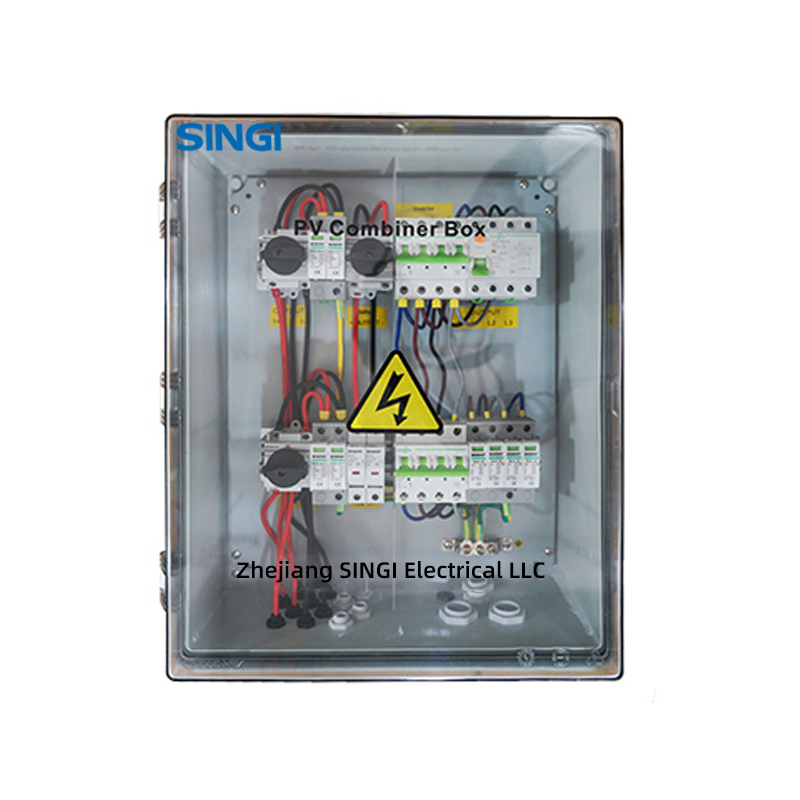
A three-phase DC+AC combiner box integrates both DC and AC circuits into a single enclosure, simplifying wiring and protection for combined solar installations. The singielectric YB4-2-2B offers 2 inputs and 2 outputs for both DC and AC sides, rated up to 1000V DC and 600V AC. This article explains its function, benefits, and choice criteria for engineers and procurement professionals.
A three-phase DC+AC combiner box is an electrical enclosure that merges multiple DC strings from solar panels and multiple AC circuits from inverters or grid connections into a single output, with integrated overamperage and surge protection. It serves as a central junction point for integrated systems where both DC and AC power paths must be managed within the same installation. The singielectric YB4-2-2B provides 2 DC inputs (each up to 1000V) and 2 AC inputs (each up to 600V) on the input side, and 2 DC outputs plus 2 AC outputs on the load side, making it a compact 2-in-2-out solution for three-phase systems.
Traditional installations use separate DC combiner boxes and AC distribution boards. Combining them in a single three-phase DC+AC combiner box reduces enclosure count, saves space, and simplifies cabling. It also allows coordinated protection between the DC and AC sides. For example, a single surge protective device can protect both circuits if properly configured. From a maintenance perspective, one enclosure means one point of inspection. However, careful thermal management and isolation between DC and AC sections are required to prevent interference.
Note: When choosing a combined combiner box, ensure DC and AC sections are physically separated by barriers or have adequate clearance to meet safety standards like IEC 61439.
The YB4-2-2B receives two DC string inputs ( from photovoltaic arrays) and two AC inputs (from inverters or backup sources) through individual circuit breakers or fuses. Inside the enclosure, the DC and AC paths are kept separate, each with its own busbars and protection devices. The outputs then feed the combined DC load (e.g., a battery bank) and the combined AC load (e.g., a three-phase grid connection). The box includes overamperage protection (fuses or MCBs) and optional surge arrestors. Its IP65-rated enclosure allows outdoor installation.
| Parameter | YB4-2-2B | Typical Separate Boxes |
|---|---|---|
| Configuration | DC+AC combined | Two separate boxes |
| DC Inputs/Outputs | 2 in / 2 out | 2-4 in / 1-2 out (DC only) |
| AC Inputs/Outputs | 2 in / 2 out | 1-3 in / 1 out (AC only) |
| Max DC Volt-level | 1000V | 1000V |
| Max AC Volt-level | 600V | 600V |
| Enclosure | IP65, single | Two enclosures |
The three-phase DC+AC combiner box is ideal for commercial and industrial integrated solar systems where both DC-coupled storage and AC-coupled grid interaction exist. Examples include:
Key choice criteria for a three-phase DC+AC combiner box include:
The singielectric YB4-2-2B meets all these criteria with a robust design and compliance to international standards.
No, the YB4-2-2B is rated for 1000V DC maximum-val. For 1500V systems, please check other models in the singielectric range.
The standard version does not include SPDs, but they can be added as an option. Customer should specify when ordering.
Yes, the IP65 rating makes it dust-tight and protected against water jets, suitable for outdoor installation.
For detailed specifications and pricing on the three-phase DC+AC combiner box 600V 1000V 2 in 2 out YB4-2-2B, visit the singielectric product page. Contact our engineering team for custom configurations.
[1] IEC 62548:2016. Photovoltaic (PV) arrays – Design requirements [S]. 2016.
[2] IEC 61643-11:2011. Low-volt-level surge protective devices – Part 11: SPDs connected to low-volt-level power systems [S]. 2011.
[3] GB/T 16895.1-2020. Low-volt-level electrical installations – Part 1: Fundamental principles, assessment of general characteristics, definitions [S]. 2020.