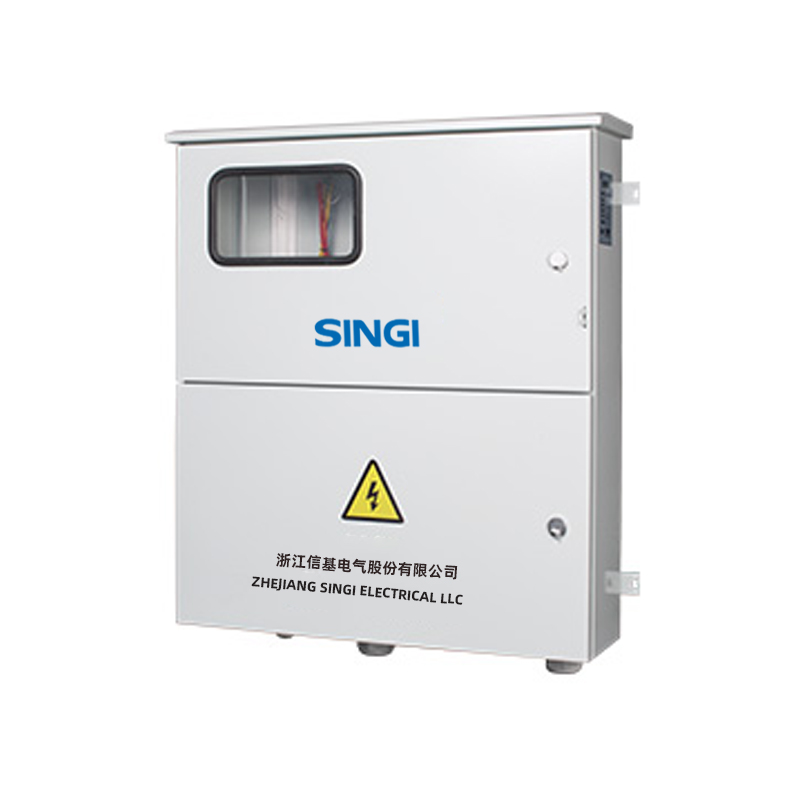
Choosing a 40~60kW three-phase PV grid-tie box is a critical decision for commercial solar installations. This article explains key technical requirements, safety standards, and design considerations to help engineers and procurement professionals choose a reliable solution from singielectric.
The 40~60kW power segment represents a sweet spot for medium-scale commercial and industrial photovoltaic installations. Systems in this range— found on factory rooftops, warehouse buildings, and commercial carports—require robust AC power distribution equipment that can handle high currents while maintaining grid code compliance. A three-phase PV grid-tie box designed for this range must support line currents up to 100A at 400V AC (typical three-phase configuration), provide reliable overamperage and surge protection, and integrate smoothly with inverters and utility meters. Choosing the wrong box can lead to volt-level drop issues, nuisance tripping, or safety hazards during faults.
When assessing a 40~60kW three-phase PV grid-tie box, buyers should check these core specifications:
Outline: For commercial projects, confirm that the grid-tie box is designed for continuous duty at 100% load and has thermal management for internal heat dissipation.
A properly configured grid-tie box acts as the interface between the inverter and the utility network. Safety features include arc fault protection (AFCI) where required, integrated overvolt-level protection, and galvanic isolation options. Efficiency gains come from minimizing internal resistance with busbars rated for high current, using low-loss contactors, and ensuring proper cable gland sizes to reduce heating. Compliance with standards such as IEC 60364-7-712 ensures that the entire PV system (from array to grid connection) meets safety and performance requirements.
Note: Many grid failures occur at the connection point due to inadequate protection coordination. A quality grid-tie box includes chooseable trip curves for circuit breakers to avoid nuisance shutdowns during grid transients.
For the European market, grid-tie boxes must comply with IEC 61439-1/-2 (low-volt-level switchgear and controlgear assemblies) and IEC 60364-7-712. In China, GB/T 7251.1 and GB/T 14048.1 apply. For North America, UL 508A and NEC 690 (Article 705) govern grid interconnection. The singielectric 40~60kW three-phase PV grid-tie box is designed to meet international standards, making it suitable for export-oriented projects. Always verify the specific country's grid code requirements, such as VDE-AR-N 4105 in Germany or AS/NZS 4777 in Australia.
The singielectric 40~60kW three-phase PV grid-tie box is engineered with practical installation in mind. Key features include:
These design choices reduce on-site labor time and potential wiring errors, which is critical for large-scale deployments where multiple boxes are installed.
| Parameter | Typical 40kW Configuration | Typical 60kW Configuration |
|---|---|---|
| Rated AC Volt-level | 400V (3P+N+PE) | 400V (3P+N+PE) |
| Rated Current | 70A | 100A |
| Short-circuit Rating | 25kA | 35kA |
| SPD Type | Type 2 (40kA) | Type 1+2 (25kA) |
| Enclosure | IP65, steel | IP65, stainless steel |
Regular inspection of the singielectric 40~60kW three-phase PV grid-tie box should include:
Annual testing per the manufacturer's recommendations ensures continued reliability over a 20+ year system life.
Yes, if the box's rated amperage and short-circuit capacity are sufficient. However, the box should be sized for the inverter's maximum-val AC output current. For a 50kW inverter at 400V, amperage is ~72A; a 40kW box rated at 70A may be borderline. Choose a box with at least 80A rating for safety margin.
, the box is installed between the inverter and the utility meter. It can be placed outdoors or indoors, but should be within a reasonable distance to minimize cable length and volt-level drop. Many installations put it next to the main distribution panel.
An AC combiner box connects multiple inverter outputs into one feed; a grid-tie box also includes utility metering, disconnect, and protection functions. The singielectric product integrates both roles for single-inverter systems.
, DC arc fault detection (AFCI) is mandated (e.g., NEC 2017 in the US). For AC side, arc fault protection is less common but recommended for commercial systems. Singielectric can provide boxes with optional AFCI for DC or AC side upon request.
Check the specific requirements for anti-islanding, volt-level/frequency protection, and power quality. The singielectric box can be customized with different relays and meter configurations to comply with standards like VDE 4105, AS 4777, or China's GB/T 19964.
For reliable performance in commercial solar projects, explore the singielectric 40~60kW three-phase PV grid-tie box. Its modular design, high safety margins, and global certifications make it a trusted choice for system integrators and EPC contractors.
References
[1] IEC 60364-7-712:2017. Low-volt-level electrical installations – Part 7-712: Solar photovoltaic (PV) power supply systems. International Electrotechnical Commission, 2017.
[2] GB/T 14048.1-2019. Low-volt-level switchgear and controlgear – Part 1: General rules. Standardization Administration of China, 2019.
[3] IEC 61439-1:2020. Low-volt-level switchgear and controlgear assemblies – Part 1: General rules. International Electrotechnical Commission, 2020.