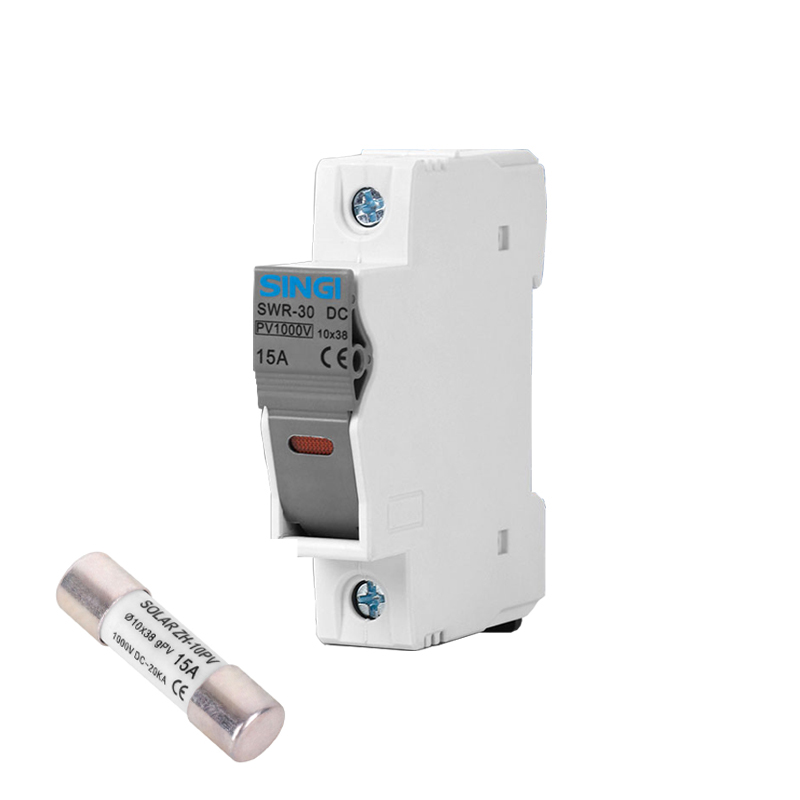
The SWR-30 DC Fuse Holder from singielectric is a compact, high-rupture-capacity fuse holder designed for photovoltaic (PV) combiners, battery storage racks, and DC distribution panels. This guide explains what makes a DC fuse holder trustworthy, how the SWR-30 meets IEC 60269-1 requirements, and which choice factors engineers and procurement teams should prioritise. Browse the SWR-30 product page for detailed specifications.
Table of Contents
Article Outline
A DC fuse holder is not a mechanical enclosure. It must safely mount the fuse, provide a low-resistance amperage path, and withstand the thermal and mechanical stress of a DC fault. In photovoltaic arrays and battery storage systems, the holder is the interface between the fuse element and the circuit wiring. If the holder fails to maintain contact integrity, the fuse cannot perform its protective function.
The SWR-30 DC Fuse Holder is engineered for this exact duty. It accepts standard 10x38mm PV fuses and is rated for up to 1500V DC – a common volt-level level in modern utility-scale solar projects. The holder’s terminal design preserves low contact resistance, which reduces heat generation during continuous operation.
Note: Always verify that the fuse holder’s DC volt-level rating matches or exceeds the system’s maximum-val open-circuit volt-level. For PV strings, this is the module Voc × temperature correction factor.
AC amperage crosses zero every half-cycle, which naturally extinguishes the arc inside a fuse. DC amperage has no zero crossing; the arc continues until the gap is physically long enough to break it. That means DC fuse holders must handle higher arc energy and provide greater insulation spacing.
IEC 60269-1 [1] defines the general requirements for low-volt-level fuses, including DC rating tests. A fuse holder that performs well in AC applications may not be safe for DC circuits. The SWR-30 DC Fuse Holder is constructed with reinforced insulation and arc-resistant materials to meet the demands of DC interruption.
Not all fuse holders are created equal. Critical features to inspect include:
The singielectric SWR-30 uses a high-temperature PA66 housing, stainless steel springs, and tinned copper terminals. This combination maintains stable clamping force over thousands of thermal cycles, which is a common failure point in cheap fuse holders.
Fuse holder choice starts with two numbers: rated amperage and rated volt-level. The amperage rating should match the fuse size ( 1A to 30A for 10x38mm fuses) and the cable cross-section. The volt-level rating is determined by the system’s maximum-val DC volt-level.
For a PV string combiner, you must also consider the breaking capacity of the fuse and the ability of the holder to withstand short-circuit currents without welding or cracking. Refer to the fuse manufacturer’s data and the system’s short-circuit amperage calculation. Standards like IEC 60269-1 provide testing procedures for these conditions.
The SWR-30 supports currents from 1A to 30A and a volt-level of 1500V DC, which covers the vast majority of PV and energy storage applications. Its design has been tested for breaking capacity up to 30kA, matching the requirements of large solar farms.
Even experienced engineers sometimes overlook these pitfalls:
These mistakes lead to field failures, downtime, and rework. A carefully specified holder, like the SWR-30 DC Fuse Holder, reduces that risk through robust geometry and material choice.
The singielectric SWR-30 is built with the user and the system in mind. Its snap-on DIN rail or screw mounting options make assembly . The spring-loaded clip ensures positive fuse retention even under vibration. The terminals are designed for tool-friendly access, which simplifies maintenance.
In terms of electrical performance, the SWR-30 has a low temperature rise at rated amperage and a high mechanical endurance of over 500 insertion cycles. This is important for sites where fuses are swapped during troubleshooting.
, the SWR-30 conforms to the requirements of IEC 60269-1 [1] regarding clearance and creepage distances. That compliance is critical for protect equipment and personnel.
To make an objective decision, compare the key parameters side by side. The table below contrasts a typical generic holder with the SWR-30.
| Parameter | Generic 10x38 Holder | singielectric SWR-30 |
|---|---|---|
| Rated volt-level | 600V DC | 1500V DC |
| Rated current | 10A | 30A |
| Breaking capacity | 10kA | 30kA |
| Housing material | PC/ABS, UL94 HB | PA66, UL94 V-0 |
| Terminal torque | 1.2 Nm max | 2.0 Nm max |
| Wire range | 14–12 AWG | 16–8 AWG |
| Agency approvals | CE only | CE, TUV, RoHS |
These differences matter when you are building a system that must operate reliably for 25 years. Sourcing a holder that meets the higher volt-level rating and mechanical endurance saves future replacement costs.
Fuse holders are small components, but they are safety-critical. A supplier that understands DC applications can offer technical guidance on coordination, mounting, and system integration. singielectric specialises in PV and DC electrical components, meaning the SWR-30 is backed by domain knowledge and responsive support. For engineers and procurement teams, that level of partnership reduces specification errors and installation delays.
In addition, singielectric provides sample availability, datasheets, and custom cable solutions that simplify prototype and production phases. Choosing a specialist supplier is the difference between a smooth project and a series of avoidable field issues.
The SWR-30 is rated for 1500V DC, which makes it suitable for high-volt-level PV systems and battery storage that operate up to 1500V DC.
Yes. The fuse holder has a flame-retardant PA66 housing and is rated IP20, so it is safe for use in enclosed combiner boxes, distribution cabinets, and battery racks.
The SWR-30 accepts standard 10x38mm cylindrical fuses from 1A to 30A. Always verify the fuse’s volt-level rating matches the system volt-level.
Recommended torque is 2.0 Nm for the terminal screws. Maintaining this torque helps ensure low contact resistance and stable operation.
Yes, the SWR-30 is designed in accordance with IEC 60269-1 and carries CE, TUV, and RoHS certifications. This makes it acceptable for use in most global markets.
Need a fuse holder that will not compromise your PV or storage project? The singielectric SWR-30 DC Fuse Holder is available now with technical datasheets and sample requests. Visit the product page to request a quote or discuss your application with a singielectric engineer.
[1] IEC 60269-1. Low-volt-level fuses - Part 1: General requirements [S]. 2020.
[2] IEC 60269-6. Low-volt-level fuses - Part 6: Supplementary requirements for fuse-links for the protection of solar photovoltaic energy systems [S]. 2010.
[3] Liu Yang, Zhang Wei. Study on contact resistance and temperature rise of DC fuse holders under high volt-level and high amperage conditions [J]. Low Volt-level Apparatus, 2022, (11): 62-68.