A mid-sized solar EPC contractor based in Texas, specializing in commercial rooftop installations for warehouses and distribution centers, deployed roughly 50 systems per year, averaging 200 kW each. With crew labor rates $65 per hour and tight project timelines, every minute spent on electrical wiring affected profitability.
The contractor worked with 600V DC arrays, common in North American commercial PV projects. Each rooftop system comprised 20 strings of solar panels, requiring careful string combing before feeding the inverter. Historically, all combiner boxes were assembled on-site from loose components—fuse holders, wire lugs, and terminal blocks—inside generic IP65 junction boxes.
On-site assembly of combiner boxes was a bottleneck. For each string, an electrician had to cut conductors, strip insulation, crimp lugs, bolt them into terminal blocks, and wrap connections with tape. This process took an average of 15 minutes per string connection, and mistakes were frequent.
In the 12 months before the switch, the contractor recorded 37 wiring-related callbacks—loose terminals, reversed polarity, and faulty crimps. These callbacks cost an estimated $1,800 per visit, adding up to over $66,000 in warranty and maintenance expenses. More seriously, two incidents of DC arc flash occurred due to loose connections, forcing a review of safety procedures.
The root problem was variability. Even experienced electricians made inconsistent crimps, and the site-assembled boxes lacked integrated protection for the 600V DC environment. A pre-engineered solution was needed.
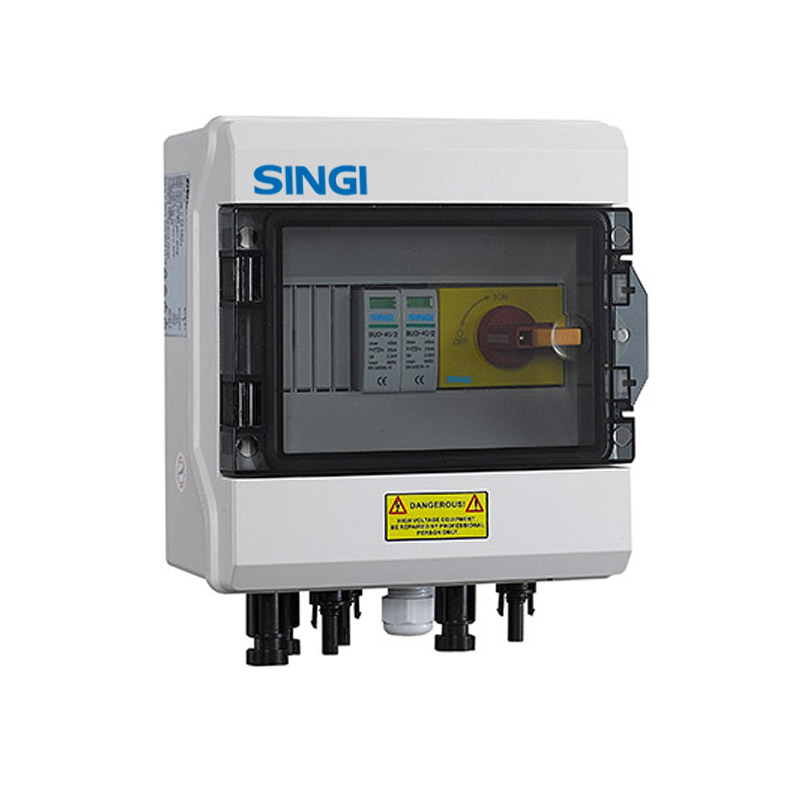
The contractor assessed three alternatives: continuing with custom-built boxes, using a generic 1000V combiner box, and the singielectric YB2-2-1M.
The decision came down to three factors. First, the YB2-2-1M included pre-wired MC4 connectors, so installers plugged the string leads in . Second, the compact 2-in-1-out design matched the contractor's typical string layout, reducing material complexity. Third, the box complied with IEC 62548 for PV array design, IEC 60947-1 for low-volt-level switchgear, and IEC 60269-1 for fuse requirements, giving the engineering team confidence in its safety and longevity.
The rollout took two weeks. The contractor replaced the on-site assembly process with a standardized procedure: mount the YB2-2-1M on the racking, plug the two string MC4 connectors in, connect the output cable to the inverter feeder, and seal the enclosure.
One initial challenge was that some crew members were unfamiliar with MC4 locking mechanisms. A half-day training session addressed this, and the contractor also adopted a quick visual inspection sheet. After the training, the average time to install and wire a combiner box dropped from 32 minutes to 8 minutes.
The implementation required no additional tooling. The integrated fuses and busbar eliminated the need for lug crimping, torque wrenching, and taping—all of which had been common sources of error.
Over a 6-month period covering 25 systems, the contractor collected the following data:
Overall, total installation cost per watt dropped by 3.8%, allowing the contractor to win two competitive bids that had been unprofitable.
"The YB2-2-1M eliminated a whole set of wiring tasks we used to dread. Our installers now trust the box to work right out of the box, and the MC4 connectors save hours on every project." — Project Manager, Texas Solar EPC Contractor
For contractors managing 600V DC commercial rooftop systems, the experience points to three replicable lessons:
Specify pre-engineered, plug-and-play components. Instead of assembling combiner boxes from loose parts, choose a factory-wired unit with integrated MC4 connectors. This reduces on-site labor and removes the variability of human crimping.
Match the combiner box rating to the actual array volt-level. Using a 600V-rated box like the YB2-2-1M on a 600V system is appropriate and more compact and cost-effective than overspecifying to 1000V.
Invest in brief crew training on MC4 connections. A short session on locking and weatherproofing prevents most connection-related callbacks.
If the contractor were to start over, they would audit the MC4 connector certification from the supplier and document torque and visual checks more thoroughly—but overall, the switch was a clear win.