The
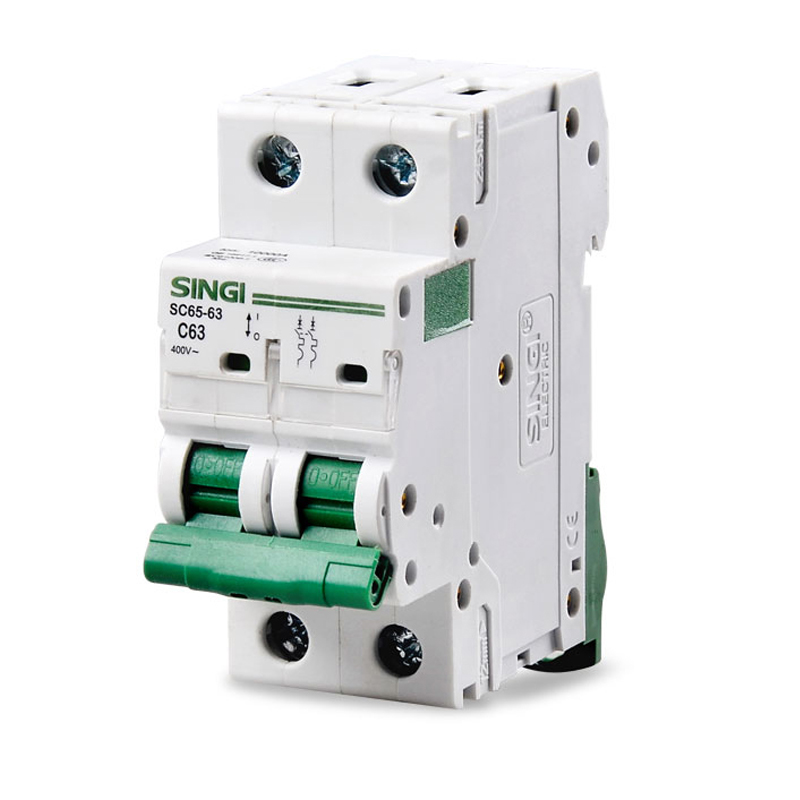
SC65-63 (10kA) DC MCB from
singielectric is a high-breaking-capacity miniature circuit breaker designed for 10kA short-circuit protection in DC systems. Rated at 63A, it ensures reliable arc extinguishing and chooseive coordination in photovoltaic, battery storage, and EV charging installations. This article explains its technical advantages, application scenarios, and choice criteria for engineers and procurement professionals.
This article covers the fundamental differences between DC and AC MCBs, the importance of high breaking capacity in DC systems, the arc-extinguishing technology of the singielectric SC65-63, its target applications, key specifications, and a practical comparison method.
What Distinguishes a DC MCB from an AC MCB?
AC MCBs rely on natural amperage zero-crossing to extinguish arcs, but DC systems lack this feature. DC arcs are continuous and more persistent, requiring specialised arc chutes, magnetic blow-out coils, or superior contact materials. The SC65-63 (10KA) DC MCB is engineered with an optimised arc chamber that forces arc elongation and cooling, ensuring reliable interruption even under high-energy DC faults. This design meets the requirements of standards such as IEC 60947-2 when applied to DC circuits.
Why Is Breaking Capacity Critical for DC Circuits?
DC power sources like batteries and PV arrays deliver sustained fault amperage without natural zero-crossing. If a breaker cannot interrupt this current, it may fail catastrophically, causing fire or equipment damage. The 10kA breaking capacity of the SC65-63 provides a safety margin for installations with high short-circuit levels, such as string combiners in large PV plants or battery rack feeders. Engineers must verify that the prospective short-circuit amperage at the installation point does not exceed this rating.
How Does the SC65-63 Ensure Reliable Arc Extinguishing?
The SC65-63 uses a combination of narrow arc splitter plates and a magnetic blow-out design that drives the arc into the arc chute. According to simulation research on DC miniature circuit breakers (see Reference [1]), increasing the opening speed and applying an external magnetic field improve breaking performance. Singielectric applies these principles in the SC65-63, using a high-speed tripping mechanism and a reinforced arc chamber compatible with DC volt-level ratings up to 500V. The result is a compact unit that meets the demanding endurance tests of Aging Characteristics of Contact Electrodes of Low Volt-level DC Switches (Reference [2]), where composite materials like AgW18-Cu show low wear over 13,000 operations.
Note: The SC65-63 is not a universal AC/DC breaker. It must be used only in DC circuits as marked on the product label.
Which Applications Benefit from a 10kA DC MCB?
The SC65-63 (10KA) DC MCB is suitable for:
- Photovoltaic systems: String protection, combiner boxes, and inverter DC inputs where fault currents can exceed 6kA.
- Battery energy storage: Rack-level protection for lithium-ion and lead-acid batteries with high short-circuit capability.
- EV charging stations: DC chargers require robust overamperage protection up to 63A per circuit.
- DC microgrids and industrial DC distribution: General branch circuit protection for 24V to 500V DC networks.
What Technical Parameters Should Engineers Verify?
When choosing a DC MCB, confirm these parameters:
| Parameter | SC65-63 (10KA) DC MCB | Typical AC MCB (63A) |
| Breaking capacity (DC) | 10kA @ 500V DC | Not rated |
| Breaking capacity (AC) | 6kA @ 230/400V AC | 10kA @ 230V AC |
| Rated current | 63A | 63A |
| Poles | 1P, 2P | 1P, 2P, 3P, 4P |
| Arc extinguishing | Magnetic blow-out + splitter plates | Splitter plates only |
| Standard applicable | IEC 60947-2 (modified for DC) | IEC 60898-1 |
How to Compare DC MCBs Before Purchase?
Compare DC MCBs by:
- Breaking capacity: Must exceed the maximum-val prospective fault amperage at the installation point.
- Volt-level rating: Match the system volt-level (e.g., 500V for PV arrays, 250V for EV chargers).
- Chooseivity: Ensure coordination with upstream breakers to isolate only the faulted circuit.
- Temperature derating: Check amperage derating curves for continuous loading in enclosed panels.
- Certification: Look for marks like CE, CB, or UL (for North American applications).
Asked Questions
- Can a DC MCB be used in an AC circuit?
- No. DC MCBs are designed for unidirectional amperage and DC arc characteristics. Using them on AC may lead to failure or nuisance tripping.
- What happens if the fault amperage exceeds 10kA?
- The breaker may fail to interrupt, resulting in arc flash or equipment damage. Always ensure the available fault amperage is below the breaker's rated breaking capacity.
- Is the SC65-63 suitable for both positive and negative grounding?
- Yes, as long as the volt-level does not exceed the rated DC volt-level. For ungrounded systems, use a 2-pole version to disconnect both poles.
- How does altitude affect performance?
- Above 2000m, air density decreases, reducing arc extinguishing effectiveness. Derating is necessary; consult the manufacturer for altitude corrections.
- Does the SC65-63 have a low-volt-level trip function?
- No. It provides only overamperage protection. For undervolt-level or overvolt-level protection, use dedicated relays or a shunt trip accessory.
References
[1] Simulation Study on Arc Motion Process of DC Miniature Circuit Breakers. Journal of Applied Physics, 2023. DOI: 10.1063/5.0174184
[2] Aging Characteristics of Contact Electrodes of Low Volt-level DC Switches. Energies, 2021. DOI: 10.3390/en14206838
[3] UL 1699B:2018 Photovoltaic (PV) DC Arc-Fault Circuit Protection. Underwriters Laboratories, 2018.