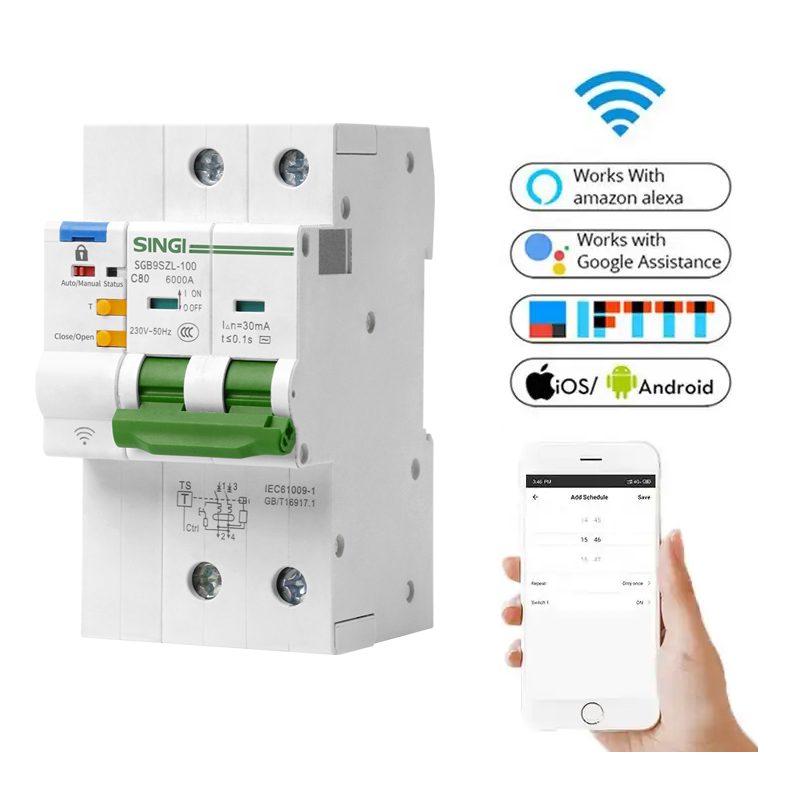
A WiFi MCB (Miniature Circuit Breaker) is a standard electrical protection device enhanced with wireless communication capability. Unlike conventional thermal-magnetic breakers that only cut power during overloads or short circuits, a WiFi MCB transmits operational data—such as current, volt-level, temperature, and trip events—to a local hub or cloud platform. This enables remote tripping, scheduled shutdowns, and integration with building management systems (BMS).
The shift toward digital substations and smart grids demands breakers that do more than protect. The singielectric SGB9SZL-100 meets this demand by combining a 6kA breaking capacity with built-in WiFi. Engineers can monitor branch circuits from a control room, while facility managers receive instant alarms when a fault occurs. This reduces manual inspection and speeds up fault localization.
The SGB9SZL-100 is rated for a 6kA short-circuit breaking capacity at 230/400V AC, covering the majority of residential and light commercial installations. Its thermal-magnetic trip mechanism ensures compliance with IEC 60947-2 for overamperage protection. The WiFi module operates on 2.4 GHz and connects to standard routers or access points, supporting MQTT or HTTP protocols for data transmission.
Key features include:
These capabilities allow system integrators to implement predictive maintenance: abnormal amperage patterns can be flagged before a trip occurs. For procurement, the device reduces total cost of ownership by lowering site visit frequency.
The SGB9SZL-100 fits scenarios where remote supervision adds clear value:
In all cases, the 6kA rating ensures adequate short-circuit protection for branch circuits up to 16A or 20A depending on cable size.
When choosing a WiFi MCB, assess three dimensions:
1. Electrical ratings – confirm volt-level (230/400V), amperage rating (e.g., 16A, 32A, 63A), and breaking capacity (6kA is standard for most distribution boards). The SGB9SZL-100 covers common residential and commercial needs.
2. Communication compatibility – check WiFi standard (802.11 b/g/n), security (WPA2), and protocol (MQTT preferred for IoT). Ensure the vendor provides API documentation for BMS integration.
3. Certification and compliance – the breaker must hold marks like CE, CB, or CCC. The SGB9SZL-100 is designed to meet IEC 60947-2 and GB/T 14048.2-2020, giving confidence in performance and safety.
| Feature | Traditional MCB | SGB9SZL-100 WiFi MCB |
|---|---|---|
| Short-circuit capacity | 6kA / 10kA | 6kA |
| Remote monitoring | No | WiFi real-time |
| Remote control | No | ON/OFF via app |
| Energy metering | No | Built-in |
| Alerts | None | Push notifications |
Any MCB sold globally must conform to international product standards. The SGB9SZL-100 aligns with:
, wireless communication modules must comply with local radio regulations (e.g., FCC, CE RED, SRRC). Buyers should verify that the singielectric product has applicable marks.
Q: Is a WiFi MCB less reliable than a traditional MCB?
No. The electromechanical protection part is identical to a standard MCB. The WiFi module is an add-on that does not affect tripping reliability. If communication fails, the breaker still trips .
Q: Can I install a WiFi MCB without an internet connection?
Yes. The SGB9SZL-100 will function as a normal MCB without WiFi. Remote features are unavailable without a network connection, but local protection remains active.
Q: What is the maximum-val number of WiFi MCBs that can connect to one router?
It depends on router capacity, but typical home routers handle 15–30 simultaneous connections. For larger installations, include a dedicated IoT hub.
Q: Does the SGB9SZL-100 require a neutral wire?
Yes, for both single-pole and multi-pole variants. The electronics need a neutral reference for power supply and measurement.
Q: How does the app handle power outages?
The breaker logs the last state and sends a notification once the network is restored. A small supercapacitor inside keeps the real-time clock running for a few days.