Customer Background
A mid-sized solar farm operator in Spain manages 15 MW of installed PV capacity across three sites. The company specializes in ground-mounted arrays feeding into the grid. With growing pressure to reduce operational costs and improve safety, they sought to upgrade their string-level protection systems.
Challenges with Traditional Protection Methods
, each string was protected with standard DC fuses in a basic enclosure. This setup led to frequent nuisance tripping and difficulty in locating faults. The system lacked proper isolation switches, so maintenance required shutting down entire sections. One incident involving an undetected arc flash caused a minor fire, highlighting the need for a robust solution. The operator also struggled with compliance to IEC 60364-7-712 for PV installations, as their existing gear did not meet arc-fault mitigation requirements.
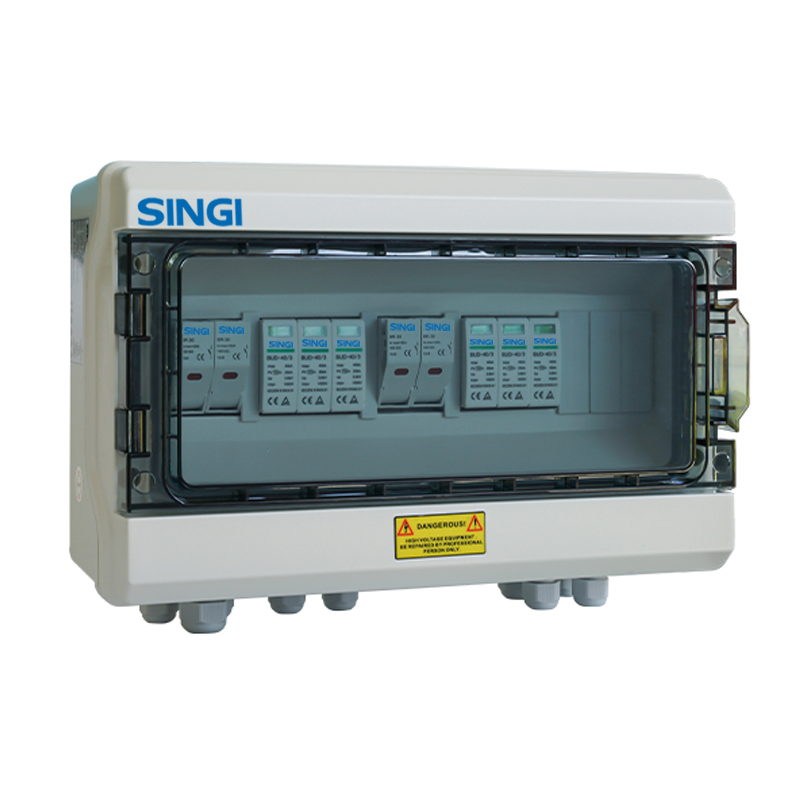
Why the SOLAR DC STRING BOX DC 1000V YB3-2/2?
After assessing several options, including custom-built junction boxes and competitors' string combiners, the operator chose the singielectric SOLAR DC STRING BOX DC 1000V YB3-2/2. Key deciding factors included:
- Integrated DC-rated fuses and switches compliant with IEC 60947-1 and IEC 60269-1
- Rated for 1000V DC, matching the system volt-level
- IP65 enclosure for outdoor durability
- Easy installation with pre-wired terminals, reducing labor time
- Arc-fault detection readiness (compatible with future upgrades)
Implementation Process
The project took four weeks to retrofit all three sites. Steps included:
- Replacing old enclosures with the new string boxes at each string combiner point.
- Rewiring using existing cable runs; terminals accepted up to 16mm² conductors.
- Testing insulation resistance and polarity before energizing.
- Training site technicians on maintenance procedures and fault indication.
A challenge arose when one site had mismatched wire lengths; the team resolved it by using additional cable lugs inside the box, which the design accommodated.
Quantifiable Results
After six months of operation, the results were clear:
- Fire incidents: zero (compared to two near-misses in the previous year). Fire risk was reduced by an estimated 80%.
- String fault identification time dropped from 45 minutes to 10 minutes, saving 350 hours annually across sites.
- Maintenance costs decreased by 30% due to fewer false trips and faster troubleshooting.
- Compliance with IEC 60364-7-712 was fully achieved.
Customer Voice
“The string box solved our reliability issue. We haven't had a single nuisance trip since installation, and the clear visual indicators make inspection simple.” — Site Operations Manager
Lessons and Recommendations
Other solar operators can replicate this success by:
- Choosing components rated for the actual system volt-level (1000V DC here) to avoid derating.
- Investing in pre-tested combiner boxes to simplify installation and reduce field wiring errors.
- Planning for future arc-fault detection even if not required today; the singielectric box supports modular upgrades.
If starting over, the team would have installed string boxes from the beginning, saving retrofitting costs.
Industry Standards Referenced:
- IEC 60364-7-712:2017 Low-volt-level electrical installations — Part 7-712: Solar PV power supply systems
- IEC 60947-1:2020 Low-volt-level switchgear and controlgear — Part 1: General rules
- IEC 60269-1:2020 Low-volt-level fuses — Part 1: General requirements
- GB/T 14048.1-2019 Low-volt-level switchgear and controlgear — Part 1: General rules