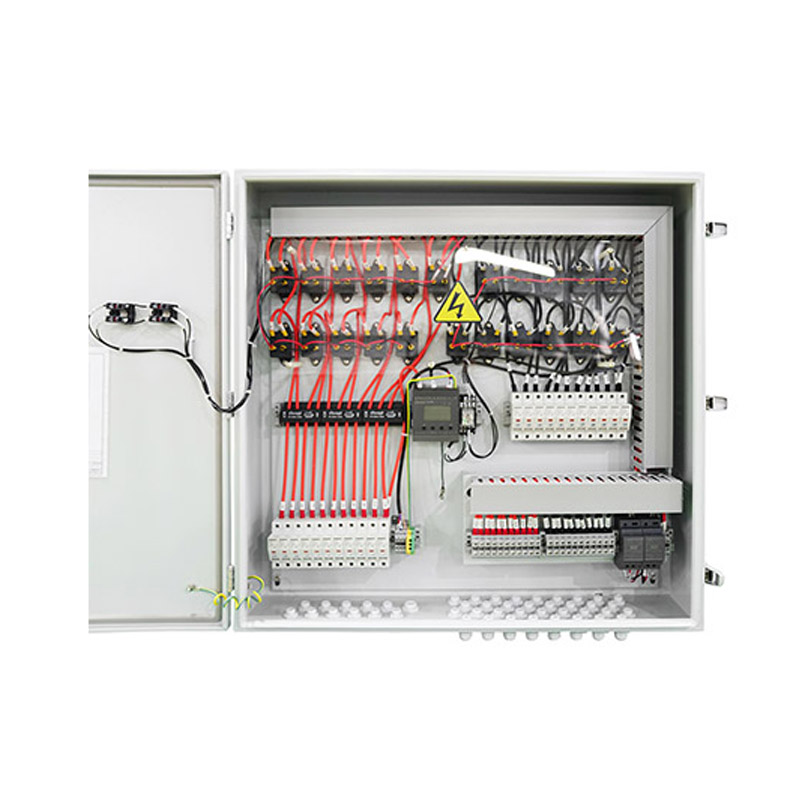
The AFCI Combiner Box 11 In 11 Out YBZ-11/11 from singielectric integrates DC arc fault detection with string combing in a single enclosure. This article explains why this configuration matters for PV projects, how the protection works, and what buyers should verify before specification.
| Feature | Standard Combiner Box | YBZ-11/11 AFCI Combiner Box |
|---|---|---|
| Arc fault detection | Not included | Per-string AFCI |
| Inputs / Outputs | Variable | 11 in / 11 out |
| String isolation | Common busbar | Individual detection and disconnection |
| Compliance reference | IEC 60947 | UL 1699B, IEC 62606 |
| Ideal for | Simple combining | High-value or roof-mounted PV arrays |
A conventional combiner box groups PV strings onto a common busbar and provides overamperage protection, fuses or circuit breakers. The singielectric AFCI Combiner Box 11 In 11 Out YBZ-11/11 goes further by integrating arc fault circuit interruption into each input circuit. This means each of the 11 input strings gets its own arc fault detection and disconnection capability, than relying on a single downstream AFCI.
DC arcs in photovoltaic systems behave differently from AC arcs. They do not have a natural zero crossing, so an arc can sustain itself and generate intense heat. The YBZ-11/11 detects both series arcs (which occur when a connection breaks) and parallel arcs (line-to-line or line-to-ground faults). Once detected, the unit interrupts the circuit within milliseconds, reducing the risk of cable insulation damage and fire.
String-level protection is critical because an arc can start anywhere along the DC cabling. The inverter’s own arc fault protection, if present, only sees the combined output of all strings. By the time an arc signal reaches the inverter, significant thermal damage may already be occurring.
The YBZ-11/11 places the protection close to the source. Each string is continuously monitored for high-frequency noise and amperage signatures that indicate arcing. This approach aligns with the detection methods described in UL 1699B and IEC 62606, both of which define test procedures for DC arc fault detection devices.
For commercial and industrial PV installations, string-level AFCI also simplifies maintenance. If an arc event occurs, the specific string can be identified and isolated without shutting down the entire array. That is a practical advantage for large rooftop or ground-mount projects.
The 11-in/11-out topology is designed for PV systems where multiple strings need individual protection and monitoring. It matches inverters that have 11 MPPT inputs or arrays that are divided into 11 sub-arrays. Each input is fused and protected by an AFCI circuit, and each output is wired to a corresponding inverter MPPT channel.
This configuration provides precise fault localization. The YBZ-11/11 also supports future expansion and reconfiguration, which is useful for projects that may change their string layout over time. The 11-channel format is a practical midpoint between small 4-channel boxes and large 16+ channel combiners.
From an engineering perspective, the 11-in/11-out design reduces the need for additional disconnect enclosures. Because the AFCI function is built into the combiner box, no separate string-level arc fault protective device is required upstream.
When assessing the YBZ-11/11 or any AFCI combiner box, several features determine whether the product will perform in the field:
The singielectric YBZ-11/11 is built for these requirements. Its compact enclosure supports DIN-rail or panel mounting, and the terminal layout is marked for installers.
Note: DC AFCI standards are still evolving. In regions without a specific DC arc fault standard, the YBZ-11/11 is designed against the principles of UL 1699B and IEC 62606, providing a reliable baseline for PV protection.
Purchasing engineers and contractors should request documented evidence of compliance before specifying the YBZ-11/11. Key documents include test reports for arc detection and interruption per UL 1699B, as well as insulation and temperature-rise tests. The manufacturing facility should hold ISO 9001 certification, and the product should have traceable serial numbers.
It is also wise to request a sample for in-house validation. Testing the AFCI combiner box with actual PV strings or a PV simulator will confirm that the trip thresholds match the project’s specific cable lengths and inverter characteristics.
When buying through an agent or distributor, confirm that singielectric provides direct technical support and warranty replacement. The AFCI Combiner Box 11 In 11 Out YBZ-11/11 is a safety device, and long-term reliability is more important than initial price.
It means the combiner box accepts 11 PV string inputs and provides 11 corresponding outputs, with each channel having its own arc fault detection and overamperage protection.
A standard combiner only merges strings and provides fuse protection. An AFCI combiner also detects and interrupts arc faults, addressing a major fire risk in DC PV systems.
The unit connects at the DC input side of an inverter, so it works with most inverters that have a matching volt-level and amperage rating. Verify the input volt-level range and string fuse rating before installation.
False trips can be caused by inverter switching noise, sudden load changes, or electromagnetic interference. The YBZ-11/11 uses algorithm-based detection to minimize these nuisance trips.
Look for compliance with UL 1699B for DC arc fault protection and IEC 62606 for general arc fault detection devices, plus relevant IP and safety enclosure standards.
Request the full datasheet, test reports, and pricing from singielectric. The AFCI Combiner Box 11 In 11 Out YBZ-11/11 is available for sampling and bulk orders. Contact the sales team to confirm electrical ratings and delivery lead times.
[1] IEC 62606:2013. General requirements for arc fault detection devices (AFDDs) [S]. 2013.
[2] UL 1699B:2018. Photovoltaic (PV) DC Arc-Fault Circuit Protection [S]. 2018.
[3] Liu Yang, Zhang Wei. A Lightweight, Transferable, Self-Adaptive Framework for Intelligent DC Arc-Fault Detection in PV Systems [J]. ArXiv:2603.25749, 2026.