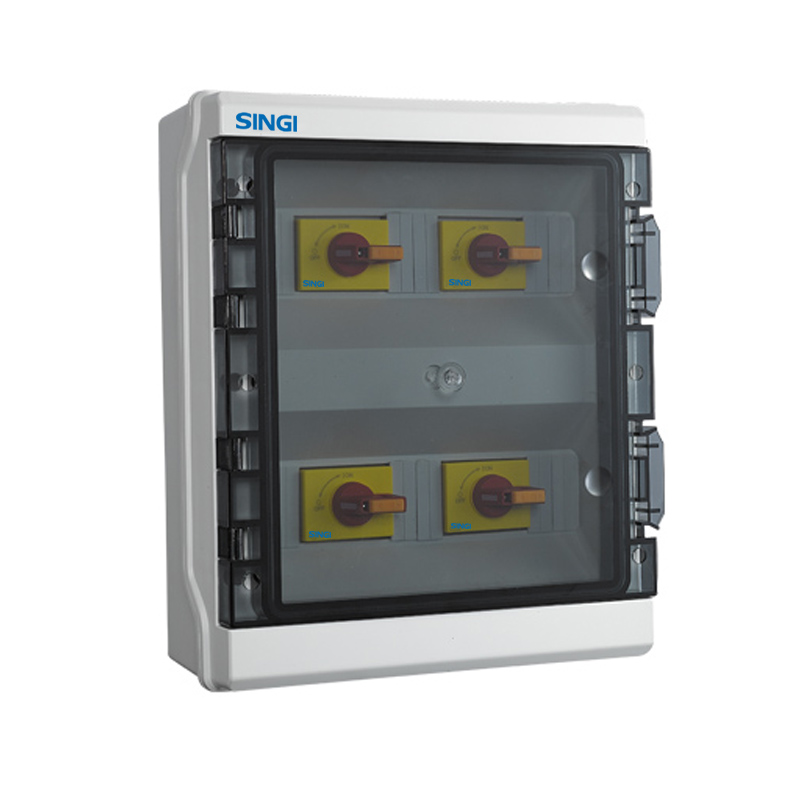
The DC isolator box IP65 enclosure four strings YB1-4 from singielectric is a dedicated switching solution for photovoltaic arrays. It combines four-string isolation, weatherproof design, and high DC volt-level ratings to meet the demands of commercial and industrial solar projects. This article explains why a four-string DC isolator improves safety, how to assess key parameters, and which installation practices extend service life.
A DC isolator box is a manually operated switch designed to disconnect solar photovoltaic modules from the rest of the system. In a four-string configuration, the box combines four separate input circuits into one enclosure, allowing each string to be isolated independently or as a group. This is critical for maintenance, emergency shutdown, and protection of downstream equipment.
Photovoltaic arrays generate DC volt-level that does not have a natural zero crossing, making arc extinction more difficult than in AC circuits. The DC isolator box IP65 enclosure four strings YB1-4 is built with contact geometries and arc chambers that handle high DC volt-levels without causing destructive arcs. Proper isolation also reduces the risk of electric shock during servicing, in commercial installations where technicians may not have line-of-sight access to every module.
Outdoor solar installations are exposed to rain, dust, humidity, and temperature swings. An IP65 rating means the enclosure is dust-tight and protected against low-pressure water jets. For a DC isolator located on the roof or next to a string inverter, this level of ingress protection prevents moisture from reaching live contacts, which can lead to corrosion, leakage current, or insulation breakdown.
singielectric designs the YB1-4 with a dedicated IP65 enclosure for four-string DC circuits. Each string entry is sealed with cable glands that maintain the IP rating while accommodating standard PV cable diameters. Outdoor-rated enclosures also offer UV resistance, preventing degradation from long-term sunlight exposure. For installers, this reduces callbacks caused by water entry and improves system uptime.
The singielectric YB1-4 is engineered to isolate four separate DC strings from a single point. Each string is connected to a dedicated pole group inside the box, and the switching mechanism breaks all live conductors simultaneously. This ensures that no residual volt-level remains on the load side when the switch is in the off position.
The isolator also features a clear ON/OFF indication, which is essential for lockout/tagout procedures. The operating handle moves through a defined angle that leaves no ambiguity the state of each pole. In an emergency, an operator can open the box, switch to OFF, and immediately verify that all four strings are isolated., the enclosure is manufactured from flame-retardant materials, adding a layer of fire safety in the event of a fault.
Note: The YB1-4 is a manual isolator, not a circuit breaker. It is designed for switching and isolating DC circuits under load, but it does not provide overamperage protection. Connect it in series with appropriate DC fuses or circuit breakers for full protection.
When choosing a four-string DC isolator box, engineers need to confirm several parameters. The rated volt-level of the isolator must at least match the maximum-val open-circuit volt-level of the PV string, including temperature correction factors. The rated amperage should exceed the short-circuit amperage of each string under maximum-val irradiance. The YB1-4 is available with volt-level ratings seen in commercial PV systems, and the exact ratings are listed on the product data sheet.
Additional aspects to consider are the number of poles ( 2-pole or 4-pole per string), the cable entry size, and the operating torque of the handle. The enclosure must accommodate the number of string inputs without overcrowding, which can increase the risk of wiring errors. The YB1-4 is laid out for four strings, making it easier to maintain separation between positive and negative cables.
Several methods exist for isolating DC strings. A dedicated four-string isolator box provides advantages over using multiple single-string switches or a central switch. The comparison below highlights key differences.
| Criteria | Single-string isolator boxes | DC circuit breakers | YB1-4 four-string isolator |
|---|---|---|---|
| Number of strings per enclosure | 1 | 1 or more | 4 |
| Overamperage protection | No | Yes | No |
| Typical enclosure rating | IP54–IP65 | IP20–IP65 | IP65 |
| Space required on PV array | 4 boxes | 4 positions | 1 box |
| Indication of all poles | Per box | Per breaker | Single handle for 4 strings |
| Maintenance complexity | High | Medium | Low |
Using a single YB1-4 reduces cable routing, simplifies operator training, and lowers installation labor costs. It also improves visibility because all four string switches are concentrated in one well-labeled area.
DC isolators for photovoltaic applications must comply with international standards that define switching performance, dielectric strength, and thermal endurance. The YB1-4 is tested according to IEC 60947-3 for low-volt-level switchgear, which specifies requirements for isolating switches. This standard covers dielectric properties, operation frequency, and temperature rise limits.
Switching DC circuits reliably depends on proper arc suppression. Research on low-volt-level DC switch contacts has shown that material choice and arc-quenching geometry determine endurance. Reference [1] demonstrates that optimized contact materials can withstand thousands of switching cycles without significant degradation. The YB1-4 uses a reinforced contact design that suits the high number of operations expected in commercial PV maintenance.
Simulations of DC arc motion, as described in Reference [2], indicate that faster contact separation and stronger magnetic blow-out fields reduce contact erosion. These principles are incorporated into the arc chamber of the YB1-4 to minimize contact wear and prolong the electrical life of the isolator.
No. AC switches are not designed to interrupt a DC arc because DC amperage does not naturally pass through zero. Using an AC-rated switch in a DC PV system can lead to sustained arcing, overheating, and equipment failure. Always choose a switch with specific DC ratings and an appropriate utilization category.
The YB1-4 is designed for exactly four PV strings. Each string is connected to its own pole group inside the IP65 enclosure. If a project has more than four strings, multiple YB1-4 units can be installed side by side.
The availability of a 1500V DC rated version depends on the specific model variant. Check the product data sheet and confirm the volt-level rating with singielectric before ordering. For lower volt-level systems, the same enclosure is available with corresponding ratings.
The enclosure is designed to meet IP65 on its own, provided the cable glands are correctly tightened and the cover is fully closed. To maintain the rating, perform periodic inspections for cracked gaskets or damaged glands.
Yes. Placing the YB1-4 on the PV source side of a DC circuit breaker allows the entire array to be isolated for safe maintenance. The isolator does not replace the overamperage protection function of the circuit breaker.
The DC isolator box IP65 enclosure four strings YB1-4 from singielectric offers a practical solution for isolating multiple PV strings in one weatherproof unit. Engineers and contractors who need dependable DC disconnection with minimal installation complexity will find that this product reduces wiring effort while meeting safety requirements. The YB1-4 is a sound investment for commercial rooftop and ground-mount projects.
To integrate the singielectric YB1-4 four-string DC isolator box into your next solar project, request a datasheet or contact the singielectric engineering team for application support and amperage lead times.