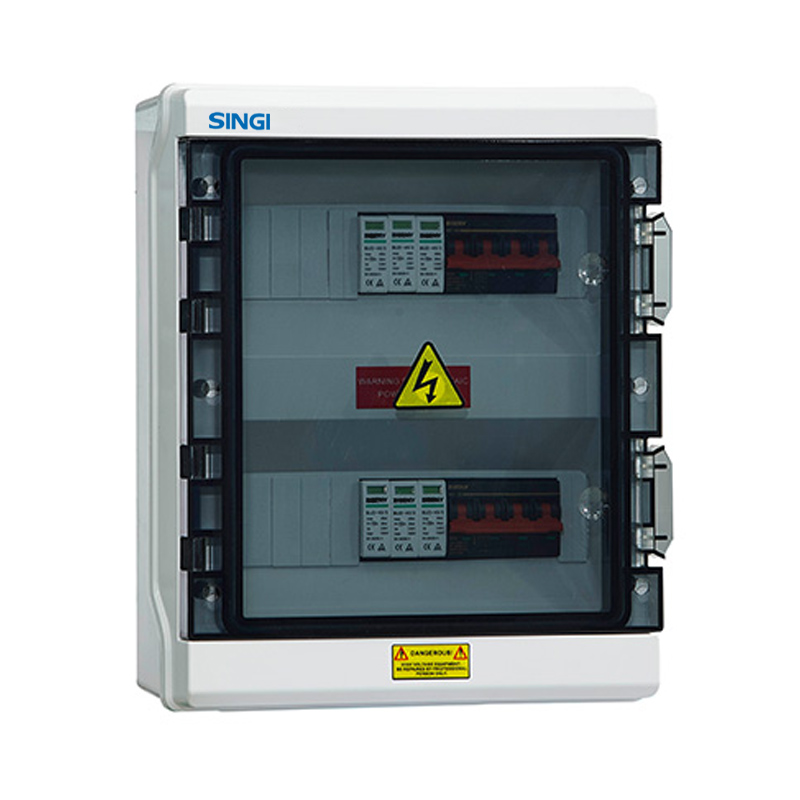
In large-scale solar photovoltaic (PV) systems, multiple strings of panels must be connected in parallel to feed power to an inverter. Without a combiner box, each string would require its own conduit and protection, increasing material and labor costs. A solar combiner box consolidates these strings into a single (or multiple) output circuits, simplifying wiring and centralizing protection. The 600V/1000V DC COMBINER BOX 4 IN 2 OUT YB2-4/2 is designed for such applications, supporting up to 1000V DC and handling 4 input strings with 2 output circuits. This reduces the number of cables running to the inverter while maintaining proper overamperage protection for each string as required by IEC 62548:2016.
The YB2-4/2 is rated for both 600V and 1000V DC systems. This dual rating allows it to be used in residential or commercial installations with lower volt-level (600V) or in utility-scale arrays with higher string volt-levels (1000V). The box accommodates 4 input strings (each with its own fuse holder) and provides 2 output circuits. The enclosure is made of corrosion-resistant materials, and the busbar is designed to handle the combined current. According to IEC 61439-1, switchgear assemblies must pass temperature rise and short-circuit withstand tests. The YB2-4/2 meets those requirements, ensuring safe operation under fault conditions.
| Parameter | Value |
|---|---|
| Max. DC Volt-level | 1000V |
| Number of Inputs | 4 |
| Number of Outputs | 2 |
| Input Protection | DC fuse or DC MCB (optional) |
| Enclosure Rating | IP65 (typical) |
| Standards | IEC 61439-1, IEC 62548 |
With a 4-in-2-out design, four PV strings are combined into two output circuits. This reduces the number of power cables running from the array to the inverter by half compared to a direct string connection. Fewer cables mean lower material costs and reduced installation time., centralized fusing in the combiner box is easier to maintain than individual string fuses scattered across the array. The DC combiner box thus lowers total system cost while improving serviceability. For large projects, this can translate into significant savings in balance-of-system (BOS) expenses.
The standard YB2-4/2 includes positive and negative fuse holders for each input string. Buyers can choose between DC fuses or DC miniature circuit breakers (MCBs) depending on fault amperage requirements. Many configurations also include surge protective devices (SPDs) to protect against lightning-induced transients, per IEC 61643-11. The box may also incorporate a dedicated ground bus. The combination of overamperage and surge protection ensures compliance with IEC 62548, which mandates protection against both overloads and surges in PV arrays.
Before purchasing a photovoltaic combiner box, confirm the following:
Consult singielectric for detailed datasheets and customization options.
No. The YB2-4/2 is rated for 1000V DC maximum-val. For 1500V systems, you would need a combiner box with higher volt-level rated components.
It depends on the order configuration. Many buyers add SPDs as an option. Check with the supplier to confirm if SPDs are included or can be added.
The YB2-4/2 enclosure is rated IP65, meaning it is dust-tight and protected against water jets. Suitable for outdoor installation.
Contact singielectric for the 600V/1000V DC COMBINER BOX 4 IN 2 OUT YB2-4/2. Get a quote today with your system volt-level, number of strings, and protection requirements.
[1] IEC 62548:2016 Photovoltaic (PV) arrays — Design requirements.
[2] IEC 61439-1:2020 Low-volt-level switchgear and controlgear assemblies - Part 1: General rules.
[3] IEC 61643-11:2011 Surge protective devices connected to low-volt-level power systems - Part 11: Requirements.