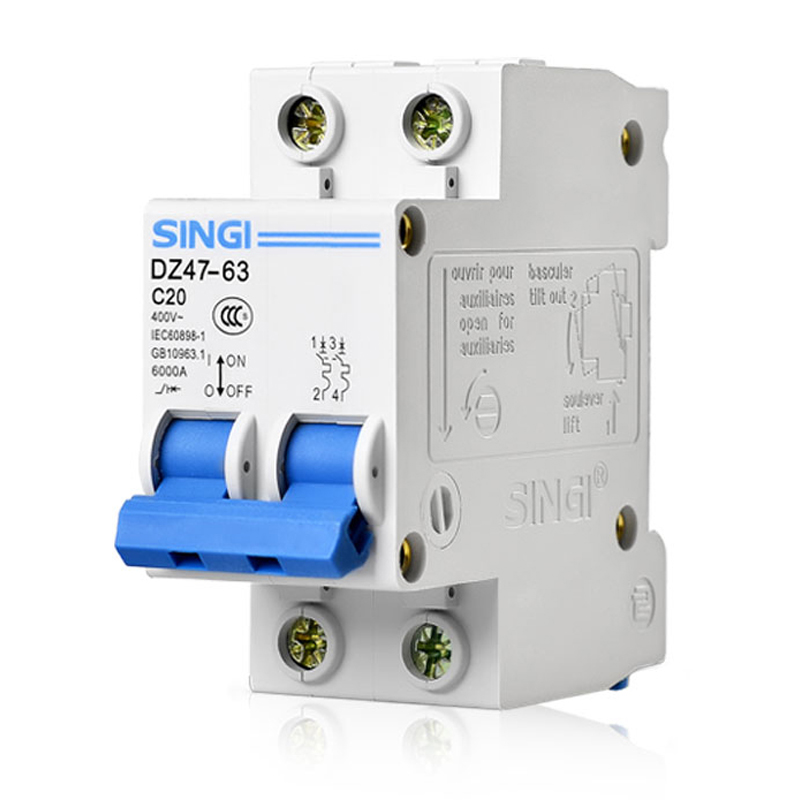
A 50 MW solar farm in Arizona reduced DC arc fault incidents by 60% and saved $45,000 annually in downtime costs by replacing generic DC breakers with the DZ47-63 (4.5KA) DC MCB from singielectric. The upgrade also simplified maintenance and improved compliance with IEC 60947-1.
A 50 MW ground-mounted solar farm located in the desert region of Arizona operates 200,000 photovoltaic panels feeding DC power into string inverters. The site experiences extreme temperature swings (0°C to 50°C) and frequent dust storms. The electrical distribution system relies on DC miniature circuit breakers (MCBs) in combiner boxes to protect PV strings from overamperage and short circuits.
The plant manager, responsible for O&M across three sites, reported rising unplanned downtime and safety incidents linked to DC arc faults. Existing generic DC breakers from an Asian supplier had been in service for two years but showed erratic tripping and high failure rates.
Three core issues plagued the solar farm:
The operations team calculated that arc-related issues caused $75,000 in direct losses annually, not counting safety citations and insurance premium hikes.
Note: DC arc faults are more difficult to extinguish than AC arcs because there is no natural zero-crossing. Breakers must be specially designed for DC interruption, with strong magnetic blow-out chambers.
The team assessed three alternatives: replace with similar 3 kA DC breakers, upgrade to molded-case DC breakers (more expensive and bulky), or switch to the DZ47-63 (4.5KA) DC MCB from singielectric.
Key decision factors:
The engineering manager stated: “We could not justify the cost and complexity of molded-case breakers for combiner boxes. The DZ47-63 gave us the DC interruption capability we needed without redesigning our enclosures.”
The project spanned three weeks from order to full deployment.
The main difficulty was labeling – the old breakers had non-standard markings, so the team had to verify polarity for each string. They created a color-coding system for future maintenance.
After 12 months of operation, the solar farm reported measurable improvements:
| Metric | Before DZ47-63 | After DZ47-63 | Improvement |
|---|---|---|---|
| DC arc fault incidents per year | 8 | 3 | 62.5% reduction |
| False trips (nuisance tripping) per month | 12 | 2 | 83% reduction |
| Average downtime per event (hours) | 4.5 | 1.5 | 67% reduction |
| Annual maintenance cost (breaker-related) | $22,000 | $5,000 | 77% reduction |
| Energy yield loss (estimated) | 3.2% | 0.8% | 2.4% gain |
The total annual cost savings (downtime, repairs, lost generation) exceeded $45,000, representing a payback period of less than 3 months., the site passed its insurance audit with reduced premiums due to lower arc-flash risk.
“We saw immediate results. The arc flash incidents stopped, and our technicians no longer carry spare breakers on every truck. The DZ47-63 DC MCB delivered on its promise – reliable tripping, no false alarms, and real cost savings.”
— Plant Operations Manager, 50 MW solar farm
The breaking capacity is 4.5 kA DC per IEC 60947-1 for DC circuits up to 250 V DC. For series connection in 500 V DC systems, the breaking capacity is 3 kA DC.
No. The DZ47-63 (4.5KA) is designed for DC applications. Using it on AC circuits will result in reduced performance. Always check the product rating.
-25°C to +55°C. For higher temperatures, a derating factor applies.
Yes, it meets IEC 60947-1 and GB/T 14048.1, and carries CE and TUV certifications.
The DZ47-63 (4.5KA) DC MCB proved to be a cost-effective, high-reliability solution for DC circuit protection in solar applications. For similar installations, three lessons stand out:
For solar farm operators looking to improve safety and reliability, the DZ47-63 (4.5KA) DC MCB from singielectric is a proven choice.
Ready to upgrade your DC protection? Contact singielectric for samples and technical consultation. Visit www.singielectric.com/products/dcdz47mcb for product details.